
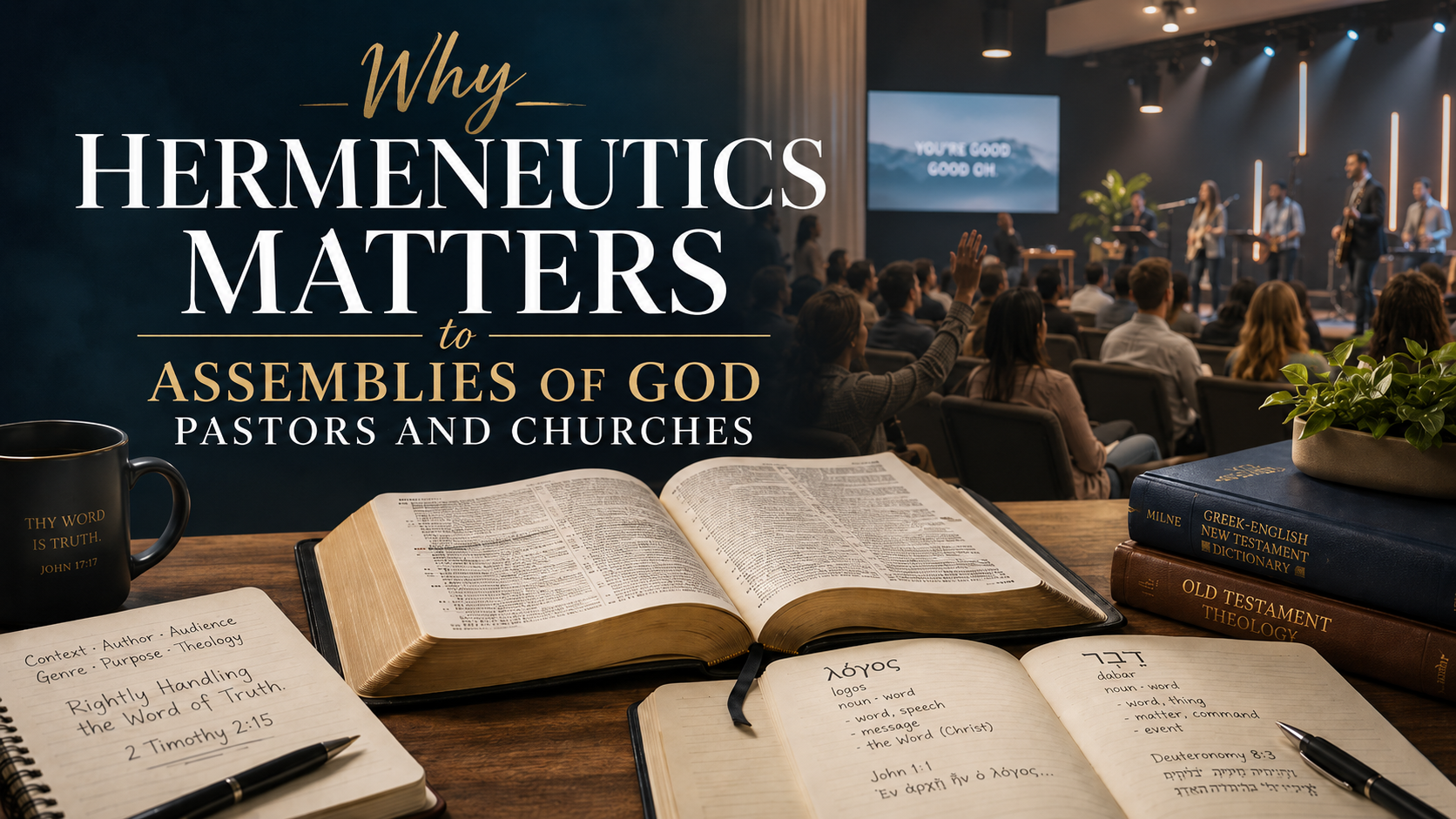
Why Hermeneutics Matters to Assemblies of God Pastors and Churches

Hermeneutics may sound like a seminary word, but it is deeply practical for every pastor, kids’ church leader, or youth pastor. Hermeneutics is the discipline of interpreting Scripture faithfully. It asks, “What did the biblical text mean when it was written, and how should it be understood and applied today?” For Assemblies of God pastors and churches, hermeneutics matters because our Pentecostal practice must be rooted in the Word of God rather than in personal opinions, experiences, or spiritual assumptions.
The Assemblies of God has always highly valued the authority of Scripture. As a Spirit-filled fellowship, we believe the Holy Spirit is active today, empowering believers with spiritual gifts and leadership. However, the work of the Spirit must never be separated from the sovereignty of God as presented in Scripture. The same Spirit who empowers the church also inspired the Word. Therefore, Assemblies of God pastors must be people of both Spirit and truth. Good hermeneutics helps us avoid the danger of carelessly using Bible verses while claiming spiritual authority.
Hermeneutics protects a church from false teaching. People can make the Bible say almost anything when verses are pulled out of context. A phrase can be misused to support unhealthy leadership, incorrect prosperity teaching, legalism, or spiritual manipulation. Verses must be interpreted in their historical setting, context, genre, and relationship to the whole word of God. This keeps the church anchored in truth and avoids confusion.
Hermeneutics strengthens preaching. Assemblies of God pastors are called to preach with dependence on the Holy Spirit. Passion without proper interpretation is a recipe for trouble. A sermon may be emotional, energetic, and memorable, yet still miss the meaning of the text or worse put the minister in a scenario where they inadvertently, or intentionally lied to their audience. Good hermeneutics gives preaching teeth that are not false, proclaiming what God has actually said, not what the preacher wants to say. In this way preaching becomes both Spirit-empowered and biblically faithful.
Hermeneutics helps churches properly understand spiritual experience. Assemblies of God churches believe in the baptism in the Holy Spirit, divine healing, spiritual gifts, prophecy, tongues, and the supernatural work of God. These are essential biblical truths to spirit filled people. Yet spiritual experiences must be tested through Scripture. Not every emotion is the voice of God. Not every dream, impression, or prophetic word carries divine authority. Hermeneutics teaches churches to welcome the Spirit’s work but also to submit to the Word. Allowing the Spirit-filled believer to be a charismatic with a seat belt of spiritual truth.
Hermeneutics shapes doctrine. As I write this, our church is going through a sermon series on the Assemblies of God’s fundamental truths, which are not built on isolated proof texts but on the broader teaching of Scripture. Doctrines such as salvation, sanctification, the baptism in the Holy Spirit, divine healing, the church’s mission, and the return of Christ require accurate biblical interpretation. Pastors who neglect hermeneutics may weaken doctrine or become imbalanced in their emphasis from the pulpit. Churches become healthier when their beliefs are not merely inherited traditions or a board member’s political opinion, or a strong-willed member’s viewpoint, but convictions formed by the rightly handled word of God above all else.
Hermeneutics makes pastors apply the Bible wisely in changing times. Assemblies of God churches minister in rural towns, suburbs, cities, prisons, hospitals, assisted living facilities, nursing homes, Gospel missions, public schools, foster care organizations, and mission fields globally. Pastors get questions about everything from gender identity to gerontology education. Pastors must reach back into the ancient text and reach out to the modern era, bringing the two together, tying eternal understanding with cords of truth without twisting Scripture into unholy knots or ignoring real-life challenges.
Hermeneutics supports the church. The Assemblies of God is a missions movement, committed to evangelizing the lost. But the mission must be guided by Scripture. The Great Commission is not a church slogan, but a mandate. Evangelism, discipleship, Spirit empowerment, compassion, and global mission all belong together. A church focused on truth without love is cold, at times cruel, and calculating. A church with weak hermeneutics, ignoring truth and always claiming “love is love” with no accountability from the Bible for anyone, becomes emaciated and easily influenced by political, ideological, denominationalism or cultural trends. A church shaped by Scripture stays focused on God’s mission.
Pastors are shepherds of souls. This is the final reason why Hermeneutics matters. People base life decisions on what they believe God is saying. They need pastors with humility, reverence, and care for God’s word. Paul directed Timothy in 2 Timothy 2:15-16
15 Do your best to present yourself to God as one approved, a worker who does not need to be ashamed and who correctly handles the word of truth. 16 Avoid godless chatter, because those who indulge in it will become more and more ungodly.
Churches should be striving to become more Godly, not more ungodly. Hermeneutics makes it possible.
This calling still matters. Assemblies of God pastors, lay leaders, and volunteers must not only preach and teach enthusiastically but also interpret faithfully. They must not only seek anointing; they must study diligently. We are all called to take our next steps with God with the belt of truth around our waist as a fruit of the presence of the Holy Spirit in our lives. May we not be caught with our spiritual pants down because we ignored appropriate Scriptural interpretations of the word of God.